 Football
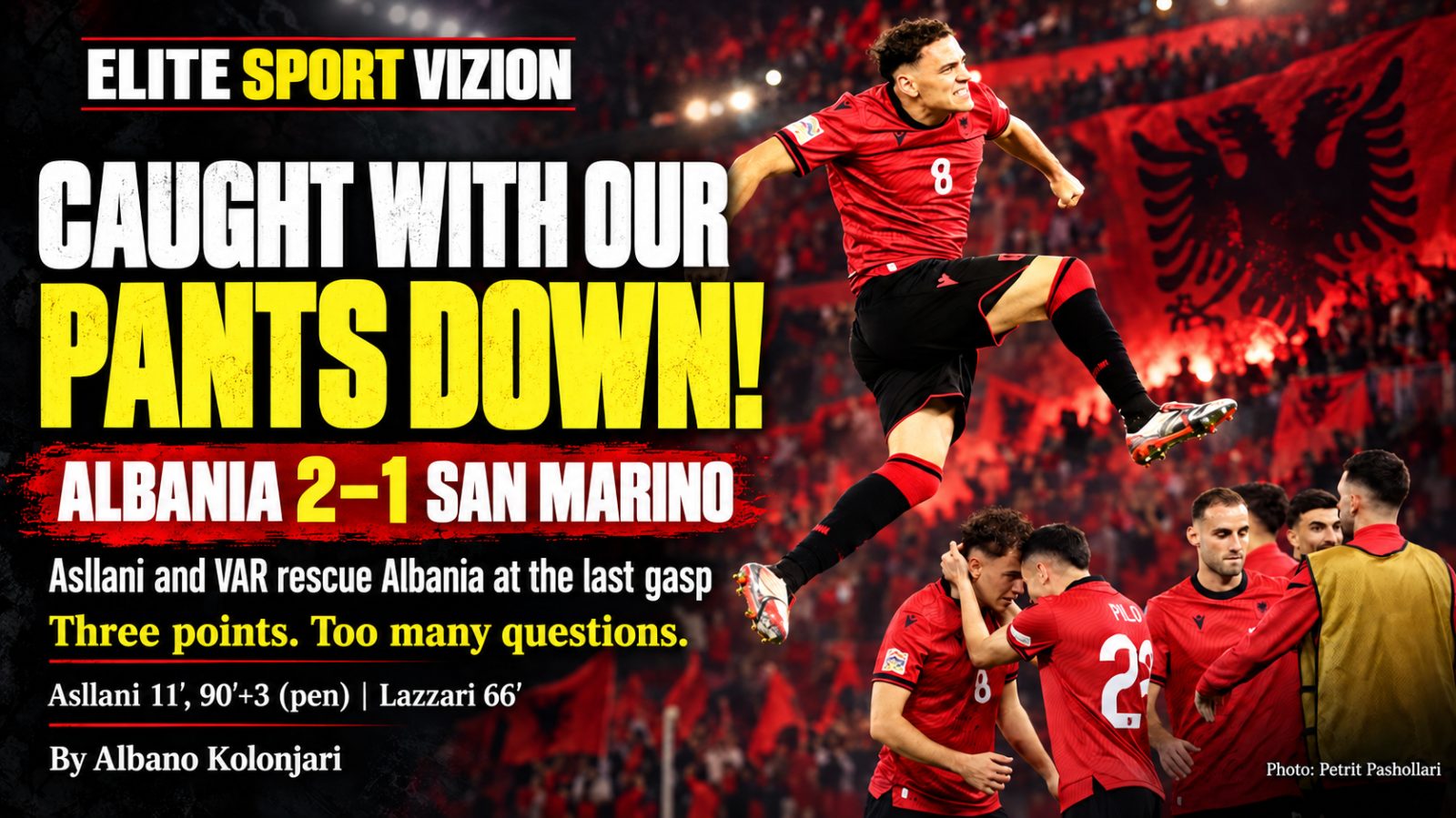
Caught With Our Pants Down!
Albania beat San Marino at the last gasp, but behind the three points lies a performance that demands accountability.
Albania beat San Marino 2–1, but anyone who watched the match will struggle to believe in this team. At the Air Albania Stadium, against the bottom-ranked side in FIFA’s world rankings, the hosts needed a “gift” of a penalty in the 93rd minute to escape an embarrassing draw.
A victory with our pants down, as the popular expression goes. Albania took the field expecting to assert their superiority and improve their goal difference, only to end up fighting desperately to avoid sporting humiliation.
In the 89th minute, the scoreboard still read 1–1. San Marino had arrived in Tirana as the opponent everyone expected us to beat and were closing in on a result that would haunt us for a long time. The anxiety inside the stadium reflected what was happening on the pitch: Albania had lost their clarity, patience and authority.
It had started so differently. Asllani’s goal in the 11th minute should have paved the way for a comfortable victory. Albania created chances but failed to take them. Then, instead of maintaining the same intensity and discipline, they began playing as though their narrow lead was enough and their opponents had no chance of responding.
That was where our failure began.
The tempo dropped, the passing lost its purpose and the midfield stopped connecting the team. The ball moved around, but the play lacked direction. The forwards searched for individual solutions while spaces opened behind them, allowing San Marino to grow increasingly confident.
A disciplined team senses when a match is slipping away. Albania waited until their opponents confronted them with the equalizer.
Lazzari scored in the 66th minute and silenced the stadium. His goal punished a warning Albania had chosen to ignore: when concentration and teamwork give way to individual ambition, with everyone trying to score and become the hero, any opponent can hurt you.
What followed was a hurried, nervous and disjointed Albania. The desire to win was obvious, but the method was missing. Everyone wanted to score. Fewer and fewer players seemed to be thinking about how the team should score.
That was one of the most troubling aspects of the evening. The national team cannot become a stage on which every player seeks his own moment of glory. When taking a shot matters more than making the right pass, the striker limits the team’s options. When everyone wants to be a hero, the team risks running out of solutions.
Captain Berat Gjimshiti acknowledged it after the match: everyone was chasing a goal, but they needed to play together. That is a damning assessment because it exposes a lack of collective discipline precisely when it was needed most.
His description of the midfield was even more painful: empty spaces, lost second balls and a more aggressive San Marino. When the captain says the opponents appeared to have more quality, any attempt to dress up this victory becomes pointless.
The midfield should have controlled the match. Instead, it allowed Albania to split into separate units. The attack searched for a goal, the defense dealt with the danger, and between them there was none of the stability that gives a team direction. In those circumstances, even a modest opponent can look formidable.
But responsibility does not end with the players. Rolando Maran must answer for the way his team lost its rhythm and for how long it took the bench to respond.
The coach admitted that Albania thought they had already won. He also acknowledged that this team struggles when it tries to slow down and manage a game. Why, then, was a known weakness allowed to recur?
That is the central criticism of his management. A problem the coach recognizes must be corrected during the match. Otherwise, the post-match analysis amounts to little more than a description of the damage.
Maran said the team was in control, even though they were playing slowly and poorly. But what is such control worth? If you fail to punish your opponents, lose your duels and allow them to grow into the game, you are simply managing risk. Albania paid for that complacency with the equalizer.
The bench should have awakened the team before San Marino’s goal awakened the entire stadium. Delayed interventions and a response under pressure turned the closing stages into a rescue operation.
The penalty arrived in the 93rd minute following a VAR intervention, and Asllani took responsibility for converting it. It was the moment that ended our nightmare, but it also showed how close we had come to failure. Albania had been reduced to waiting for a last-gasp spot kick to beat San Marino at home.
Asllani deserves credit for his goals and his composure at the end. But the national team cannot depend on one player to solve what his teammates and the coaching staff have spent almost the entire match complicating.
The three points keep us top of the group. Yet first place does not erase what we witnessed. If anything, it should make us more concerned: we have an opportunity to win the group, and we are jeopardizing it with a style of play that falls apart as soon as concentration drops.
San Marino deserve respect. They fought, believed and exploited our weaknesses. Nobody forced us to underestimate them. Responsibility for this evening belongs to Albania: to the players who lost their discipline and to the coach who failed to stop the decline in time.
The supporters backed the team until the end. They came to watch a national side play with pride and ended up praying for salvation in the final minutes. Their loyalty deserves far more commitment on the pitch.
This is not the Albania we want. We want a team that respects its opponents by giving its maximum, forwards who work for the team’s goals, and a coach who solves problems before they become a crisis.
This victory must be followed by a rigorous assessment and visible changes. “We took the three points” is not enough. Nor can the chances created in the first half serve as an excuse for what happened afterward. Football demands that you finish the job you start.
At the Air Albania Stadium, Albania won the match but failed the test of professionalism. The penalty saved us this time. In the next match, the team must be capable of saving itself.
Albania fielded their first-choice side and produced one of their weakest performances. Maran and his staff bear full responsibility for the team’s preparation, organization and management.
Against an opponent such as San Marino, fatigue cannot serve as an excuse. If the regular starters were tired, where were the alternatives? Where is the next generation? Where are the 17- and 18-year-olds? Across elite football, teenagers are being given opportunities and succeeding, while Albania struggle even with their first-choice team.
That raises serious questions about squad depth, selection and the willingness to trust emerging talent. No player should be selected simply because he is young, but no established player should have a guaranteed place regardless of his performance. The national team needs genuine competition and credible alternatives.
In 36 days, Albania will host Finland at the Air Albania Stadium. Three days later, they will face Belarus in Hungary. Maran has little time to put these problems right. The midfield needs cohesion, the attack needs cooperation, and the team needs greater defensive security.
Above all, we need reliability in goal. Let us hope for Strakosha’s full recovery, but the coaching staff must also have a dependable solution if he remains unavailable.
Maran, time is running out. You know the players now. You have seen the weaknesses and acknowledged them yourself. What is needed next is decisive action and improvement on the pitch.
The penalty rescued the result. It cannot rescue the performance, excuse the mistakes or absolve those responsible.