 Football
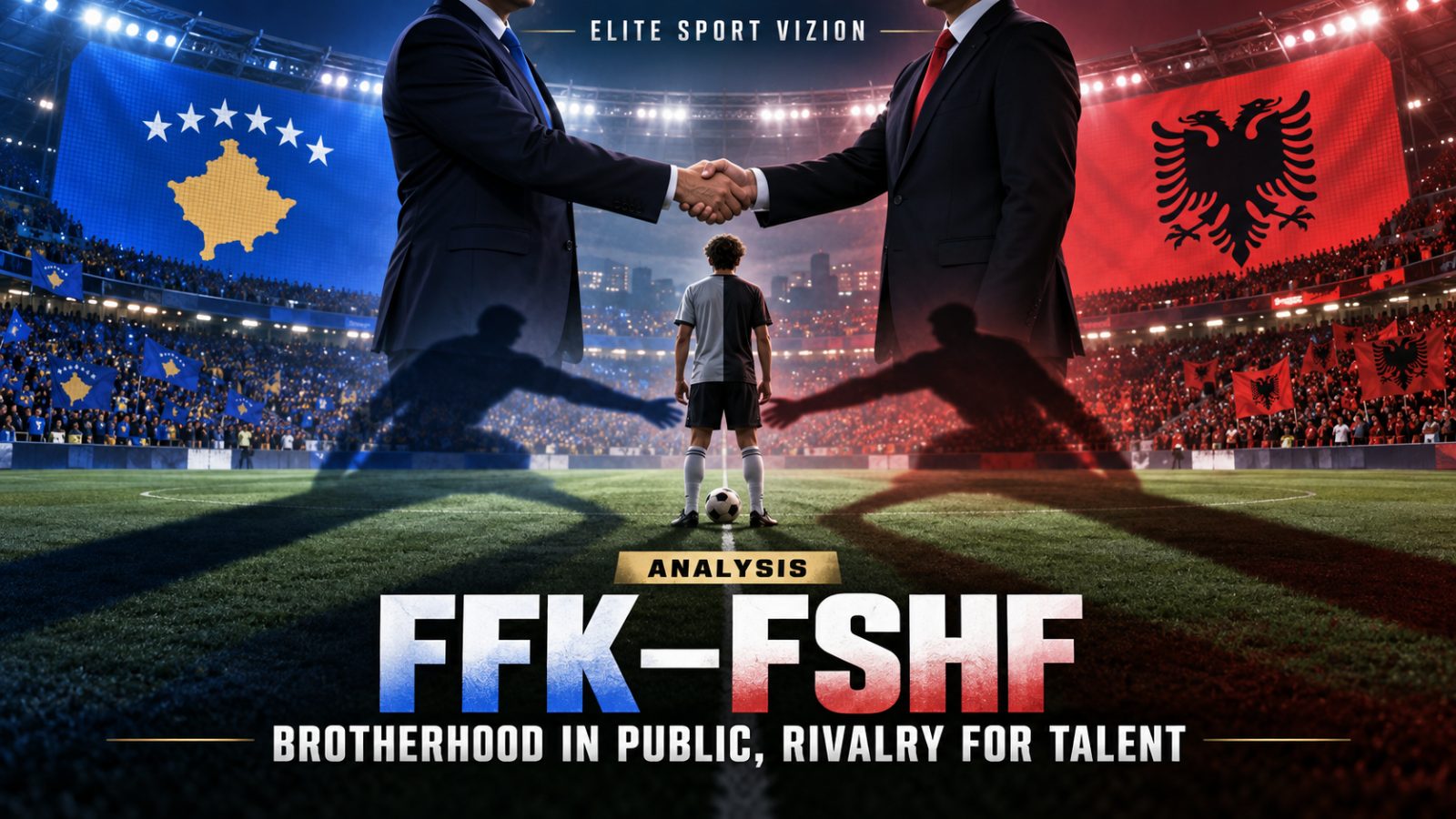
FFK–FSHF: BROTHERHOOD IN PUBLIC, RIVALRY FOR TALENT—ARE CRACKS APPEARING BEHIND THE FACADE?
From the case of Etnik Brruti to the departure of youth internationals, relations between the two federations continue to raise questions. Officially, the message is one of cooperation, but the competition for Albanian players continues to generate tension, accusations and disappointment
Relations between the Football Federation of Kosovo and the Albanian Football Association are publicly presented as excellent and brotherly. Agim Ademi and Armand Duka meet, exchange congratulations, support each other in international forums and discuss joint projects.
Nevertheless, beyond official photographs and diplomatic statements, there is continuing competition for Albanian footballers—particularly diaspora talents and players developed within Kosovo’s youth national teams.
Are relations between the FFK and FSHF like a beautiful apple on the outside, but with hidden problems within?
The facts do not demonstrate the existence of an open institutional war. However, a series of controversial cases suggests that behind the language of cooperation lie different sporting interests and genuine competition to secure players.
Two Federations, One Talent Pool
Kosovo and Albania are two states with two separate federations independently recognized by UEFA and FIFA. Each has the interest, responsibility and right to build its own national teams.
The problem arises because both federations recruit players from almost the same pool: Albanian footballers playing in Kosovo, Albania and across the European diaspora.
Before Kosovo was admitted to UEFA and FIFA in 2016, Albania was the main international option for Albanian players from Kosovo. The situation changed after the FFK gained recognition. Kosovo began developing its own national-team project, while many players found themselves facing an emotional and professional choice.
On one side stands Albania, with its longer international tradition and appearances at Euro 2016 and Euro 2024. On the other is Kosovo, a state seeking to build its own sporting identity and history.
FIFA regulations allow players to change their sporting association when the relevant criteria are satisfied. FIFA has also established a public platform where decisions concerning changes of association are recorded once they become final. The choice is therefore not determined by the wishes of federation presidents, but by the player’s will and international regulations. (FIFA)
Etnik Brruti, the Case That Ignited the Debate
The most symbolic case in this dispute was the 2025 move of Etnik Brruti—not “Milot Brruti”—from Kosovo U21 to Albania U21.
Brruti had worn the captain’s armband for Kosovo U21. His decision to join Albania provoked strong reactions in Kosovo and placed him at the center of accusations of “betrayal.”
His father, Besnik Brruti, responded by defending his son’s decision:
“My son made a decision rooted in his convictions and his love for the nation. He did not reject Kosovo; he chose to play for the Albanian national team.”
He emphasized that, for their family, Kosovo and Albania represent “one nation, one blood and one history.” (KOHA.net)
Former Kosovo U21 coach Afrim Tovërlani used much harsher language. Speaking about players who were leaving Kosovo, he stated:
“I have no comment about players who are betraying the Dardanian jersey and playing with our work. Our players are being deceived by certain quasi-agents who are enticing them.”
His statement demonstrated that the issue was not perceived solely as a player’s personal choice. Within Kosovo’s system, such departures were viewed as a blow to the work of its coaches and the FFK’s investment in youth national teams.
However, describing an Albanian footballer who chooses Albania as a “traitor” moves the debate away from sporting arguments and into the territory of moral and national judgment.
Armand Duka responded to the criticism by drawing a comparison with Albanian players who have represented other countries:
“We were proud that Xhaka played for Switzerland; why are you upset that Brruti plays for Albania?”
In this way, the FSHF president presented Brruti’s decision as an exercise of free choice rather than Albania “taking” a player away from Kosovo. (KOHA.net)
Dion Berisha and Allegations of Neglect
Another case that generated debate involved Dion Berisha. The player had represented Kosovo at several youth levels before choosing Albania U21.
His father, Ekrem Berisha, said that his son had become disappointed with the way he was treated by the FFK. According to him, the Albanian federation had monitored and valued the player more consistently.
This was a serious allegation concerning the FFK’s management of young talent, but it remains the position of the player’s family rather than an independently established conclusion. (Gazeta Nacionale)
The case showed that not every departure can be explained by patriotism, passports or the influence of agents. Sometimes the decision may also be connected to communication, sporting plans and the level of respect a player believes he receives from a federation.
Blerton Isufi and Institutional Confusion
The case of Blerton Isufi highlighted another problem: the absence of clear communication between a player and the national-team structures involved.
In May 2026, Isufi’s name appeared on the Albania U21 squad list. The player subsequently stated that he had not approved such a move and intended to continue representing Kosovo.
His position raised questions about how his name had been included in the squad and about the communication that had taken place between the player, his representatives and the FSHF. (Shqiptarja.com)
Media reports presented different versions of events, but there is insufficient evidence to state as fact that the player had accepted Albania’s invitation and then withdrawn under pressure.
This is precisely one of the central problems surrounding the FFK–FSHF debate: partial information is quickly transformed into accusations of deception, betrayal or “theft,” while the complete version of events is often missing.
The Dellova Case and Contradictory Statements
Lumbardh Dellova’s name also became part of the debate after media reports suggested that the defender could receive an invitation from Albania.
Agim Ademi expressed dissatisfaction with the idea that the FSHF might contact or invite players who were part of Kosovo’s national-team project. He later clarified that he had no personal conflict with Armand Duka and that no footballer could be forced to represent Kosovo against his will.
Duka, meanwhile, has stated that Albania does not conduct a secret “hunt” for players and that the national team’s doors are open to every Albanian footballer who wishes to wear the red-and-black jersey.
This is where the central contradiction lies: the FSHF presents contact with an Albanian player as a normal sporting right, while the FFK may view the recruitment of a player developed and fielded within Kosovo’s structures as interference in its project.
Genuine Cooperation or Diplomacy Driven by Interests?
It would be inaccurate to claim that the FFK has opposed every joint project with Albania.
In 2019, Agim Ademi and Armand Duka supported the idea of a joint Albania–Kosovo cup competition, which was expected to be called the “Mother Teresa Cup.” The project sought to provide its winner with a place in European competition, but it required UEFA approval. (Panorama Sport)
The two federations have also cooperated in areas such as coaching education, licensing, infrastructure projects and youth activities.
Their relationship is therefore neither purely conflictual nor purely brotherly. It is a mixed relationship in which institutional cooperation coexists with sporting competition.
Duka and Ademi have an interest in cooperating within UEFA and FIFA, but they simultaneously lead two federations competing for many of the same players. That is the contradiction diplomatic statements cannot eliminate.
Conflicts with Kosovo Players Make the Situation More Serious
The debate surrounding relations with the FSHF has gained greater importance following the latest conflict between Amir Rrahmani and the current FFK leadership.
When Kosovo’s captain declares that he cannot continue playing for the national team for as long as the federation remains under its current leadership, the problem can no longer be explained solely by outside interference or Albania “enticing” players.
Rrahmani’s legal representative, Taulant Hodaj, has raised allegations involving pressure, threats and potentially unlawful actions by individuals connected to the federation. These allegations remain subject to verification by the competent authorities, while the FFK must be given the opportunity to present its complete version of events.
The captain’s departure nevertheless shows that the FFK is also confronting an internal crisis of trust.
The federation may criticize Albania when it loses a talented player, but it must also ask itself why certain footballers developed within its own structures decide to leave—and why the senior national-team captain reached the point of entering into a public conflict with its leadership.
One National Team and Two Stadiums?
For years, some Albanian supporters have advocated the idea of a united national team that would play in both Tirana and Pristina. Others have proposed a joint league or cup competition involving clubs from Albania and Kosovo.
Supporters of this idea argue that combining the sporting potential of both countries would create a stronger national team and a more competitive football market.
Opponents emphasize that Kosovo fought for years to secure international recognition and that losing independent representation would weaken the state’s presence in international sport.
Both positions deserve debate. However, a single national team cannot be created solely through the wishes of supporters. Albania and Kosovo are separate members of UEFA and FIFA; any merger would require major political, legal and institutional decisions.
While the idea of a single league faces regulatory obstacles, a joint cup, youth tournaments, coordinated academies and transparent agreements concerning players represent more realistic objectives.
Footballers Are Not the Property of Federations
Neither the FFK nor the FSHF should treat players as institutional property.
A footballer who chooses Kosovo is not acting against Albania. A footballer who chooses Albania should not automatically be declared a traitor to Kosovo.
The federations should compete through their projects, professionalism, fair treatment and sporting opportunities—not through pressure, labels and propaganda campaigns.
If the FFK wants to retain talented players, it must persuade them through organization and a clear sporting perspective. If the FSHF wants to recruit them, it must do so transparently and without damaging relations with the Kosovar federation.
Relations between the FFK and FSHF may officially be good, but the cases involving Brruti, Berisha, Isufi and Dellova demonstrate that the competition for talent is real.
Perhaps the apple is not necessarily rotten. But its polished exterior must not be used to conceal the problems that exist within.
Albanian football, in both Albania and Kosovo, needs less empty diplomacy and greater transparency. Ultimately, the winner should not be one president or one federation. The players, the supporters and Albanian football as a whole should be the ones who benefit.
Editorial note: The statements and allegations mentioned in this analysis are attributed to the individuals and sources that published them. They are not presented as established facts in the absence of a final institutional or judicial determination.