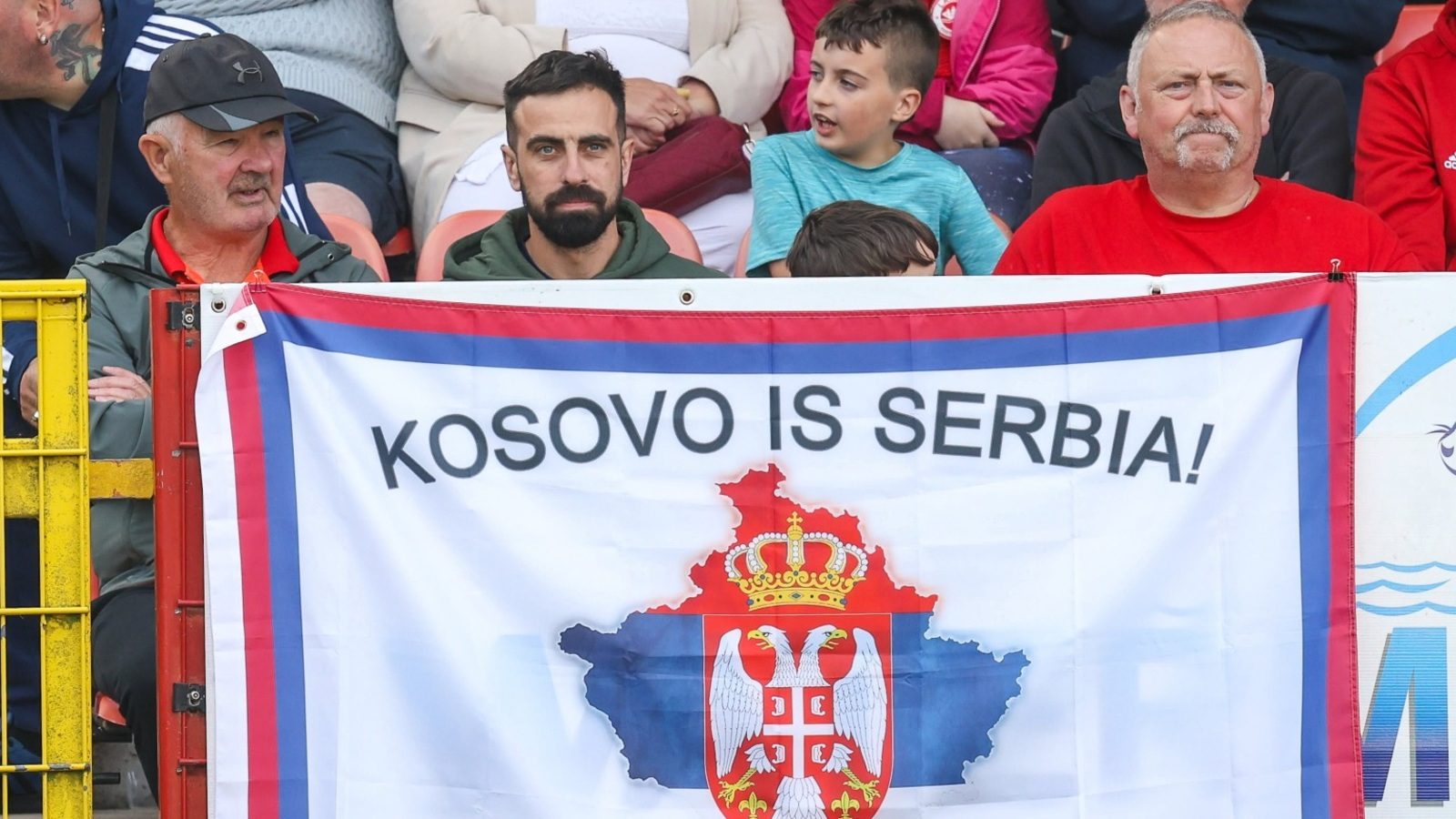
“Kosovo Is Serbia” at Inver Park: UEFA Cannot Remain Silent Over Crvena Zvezda’s Provocation
UEFA Champions League
Football should have been the main story of the evening at Inver Park, but following Crvena Zvezda’s 4–0 victory over Larne FC, the sporting result was overshadowed by an open political provocation against Kosovo.
A message was published on Crvena Zvezda’s page in Serbian and English:
“Косово је Србија! Хвала Larne Football Club.” “Kosovo is Serbia! Thank you Larne Football Club.”
This was neither a sporting message nor a routine celebration after a victory. It was a provocative political slogan that has no place at a UEFA event, denies Kosovo’s statehood and uses football as a vehicle for political propaganda.
Crvena Zvezda won convincingly on the pitch. Bruno Duarte scored in the 26th minute from the penalty spot and again in the 67th, while Kostov struck in the 55th minute and Cham completed the 4–0 victory in the 85th.
However, no victory—regardless of the score—gives a club the right to turn a Champions League match into a platform for nationalism.
The message thanking Larne FC demands an explanation
The most troubling part of the publication was the message addressed to the home club: “Thank you Larne Football Club.”
Why did Crvena Zvezda thank Larne FC immediately after publishing such a slogan? Was the host club aware of it? Was its display or production allowed inside Inver Park? Did stadium personnel intervene to stop or remove it? Is there evidence recorded by security cameras or mentioned in the UEFA match delegate’s report?
These questions do not automatically prove that Larne FC approved the message. However, they are serious enough to require a thorough investigation.
If it is established that Larne FC’s officials authorised, facilitated or knowingly tolerated the display of the banner, then disciplinary responsibility cannot fall on Crvena Zvezda alone. The match organisers must also be held accountable.
Being a welcoming host does not mean allowing your stadium to be used to deny the existence of a state and provoke its people. Sporting hospitality ends where political propaganda begins.
The FSHF and FFK must act together
The Football Federation of Kosovo and the Albanian Football Association must respond immediately and in a coordinated manner.
A symbolic statement on social media is not enough. Both federations should submit an official complaint to UEFA, supported by Crvena Zvezda’s publication, photographs, video footage and any other evidence from the stadium.
They should demand:
The opening of disciplinary proceedings against Crvena Zvezda; An investigation into the role of Larne FC and the stadium authorities; The preservation and review of security-camera footage; An examination of the reports submitted by UEFA’s match delegate and security officer; Appropriate disciplinary action against every club or official found responsible.
UEFA’s Disciplinary Regulations prohibit the use of words, objects or any other means to transmit provocative messages that are not suitable for a sporting event, particularly those of a political, ideological, religious or offensive nature.
Silence would create a dangerous precedent
Kosovo is a full member of UEFA. Its national team and clubs compete under the flag and institutions of the Republic of Kosovo. A message denying its existence is therefore not only an attack on Kosovo but also a challenge to UEFA’s own authority.
If European football’s governing body tolerates this incident, stadiums could soon be filled with other political, territorial and nationalist slogans. Football would then cease to be a sporting arena and become a battlefield for propaganda.
The Albanian response should not be another provocation. It must be institutional, documented and forceful:
Kosovo does not need slogans to prove its existence. Crvena Zvezda and Larne FC must explain how such a message became associated with a UEFA match.
Crvena Zvezda won 4–0 on the pitch, but European football lost the moment political propaganda took the place of sport.
The ball is now in UEFA’s court. Silence is not neutrality—it is tolerance of provocation.