 Football
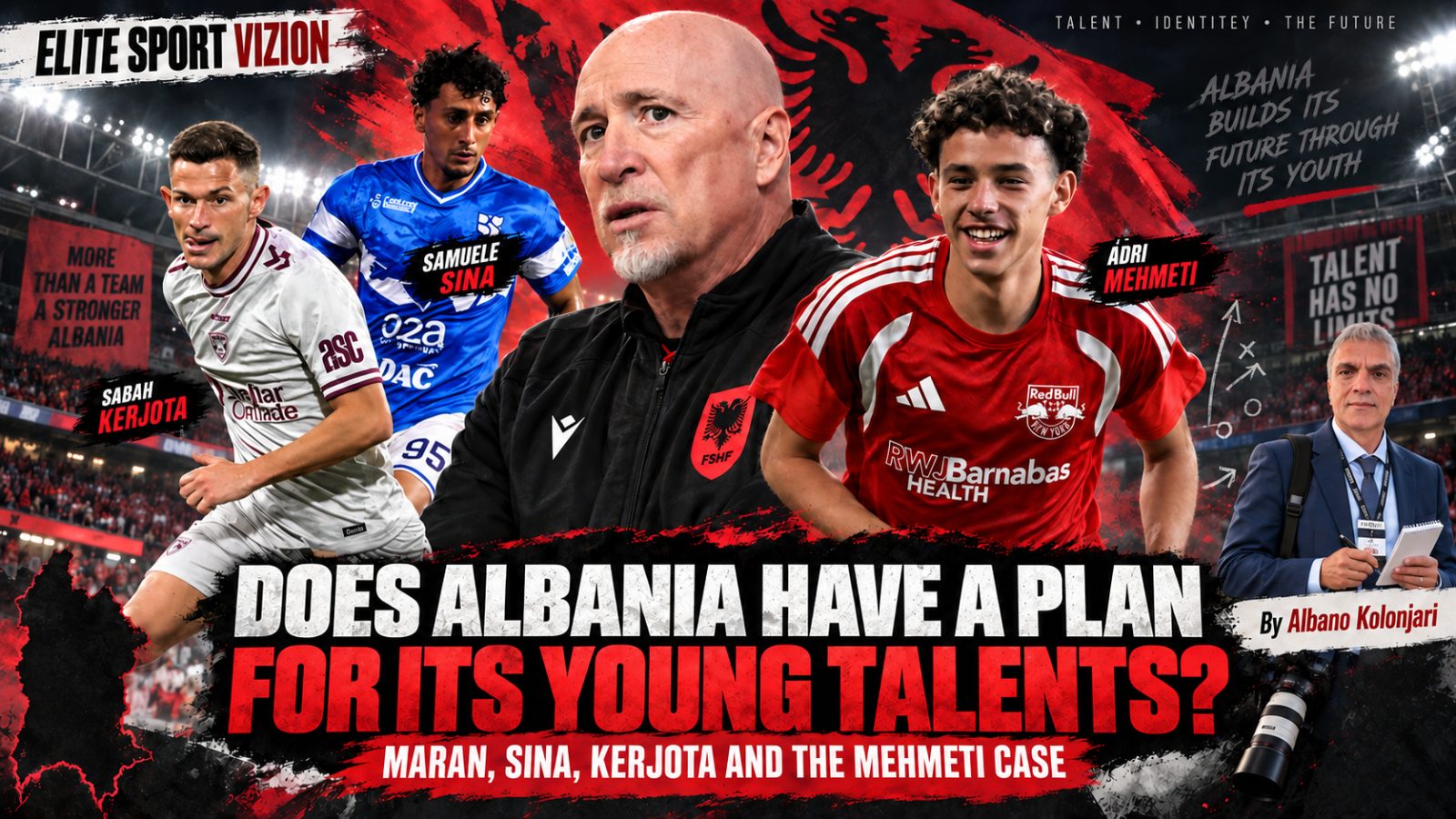
Maran, Sina, Kerjota and the Mehmeti Case: Does Albania Have a Plan for Its Young Talents?
Rolando Maran’s squad selection for Albania’s next four matches surprised the country’s football community. Important players such as Armando Broja, Jasir Asani and Nedim Bajrami were left out, while Samuele Sina and Sabah Kerjota received their first senior call-ups.
Sina and Kerjota are not widely known among Albanian supporters and currently do not play for clubs at the highest level of European football. However, that does not mean they do not deserve this opportunity.
The responsibility for selecting the squad belongs to the coach. We will also reserve our judgment on these two players until we see them on the pitch. Every Albanian footballer who performs well should have the opportunity to represent the national team.
Samuele Sina has previously played for Albania at U-17 and U-19 level. Sabah Kerjota, however, does not appear to have represented Albania’s youth national teams, according to the available records.
Their selection is not the problem. The real concern is that, even in an expanded squad, Maran did not create room for some of the young talents who have progressed through Albania’s youth system and have been described as the future of the national team.
This raises several questions that deserve answers.
What is the purpose of the U-17, U-19 and U-21 teams if the players developed within them are forgotten before they can knock on the door of the senior national team?
Why must Albania wait for another country to show interest in an Albanian talent before remembering him?
Most importantly, does Albania have a genuine project for integrating young players, or does everything depend on the squad selection and result of the next match?
When Albania Trusted Players Who Were “Still Wet Behind the Ears”
The history of the Albanian national team disproves the idea that a footballer must be 23 or 24 years old before receiving an opportunity.
In the past, Albania trusted players and goalkeepers who, as an Albanian saying goes, “still had milk on their lips.” Yet once they stepped onto the pitch, they proved that talent is not measured by a birth certificate.
Qemal Vogli, one of the greatest goalkeepers in our history, made his Albania debut in May 1947 at just 17 years of age. At the time, he became the youngest goalkeeper to wear the national-team shirt and later developed into a legendary figure in Albanian football.
Iljaz Çeço made his senior international debut against Algeria on October 11, 1964, at the age of 17. He was still a teenager, but coach Zyber Konçi had the courage to send him onto the pitch. Çeço later became one of the most important midfielders in Albanian football.
Medin Zhega was only 19 years and three months old when he played his first match for Albania in 1965. He went on to become an important figure for both Vllaznia and the national team.
Sulejman Demollari made his debut in April 1983 at the age of 18 years and 11 months. Nobody claimed that he was too young or needed to wait. His talent was trusted, and Demollari became one of the greatest footballers Albania has ever produced.
Perhaps the most remarkable example is Blendi Nallbani. The goalkeeper known as “Tata” made his senior debut against England at Wembley Stadium on April 26, 1989, when he was only 17 years, 10 months and 27 days old.
An Albanian teenager was placed in goal against one of the world’s strongest national teams at one of football’s most famous stadiums. Albania lost 5–0, but Nallbani’s performance earned praise from the English media. He demonstrated that a young goalkeeper can handle enormous responsibility when someone has the courage to trust him.
These players did not become great before receiving their national-team opportunities. They became great partly because Albania gave them the opportunity to develop.
Modern Albania Has Also Trusted Young Players
In the modern era, we have the example of Mario Mitaj, who made his senior Albania debut against San Marino on March 31, 2021, at the age of 17 years and seven months. He had progressed through Albania’s youth teams and was naturally promoted to the senior side.
Today, Mitaj is one of Albania’s important players. If he had been considered “too young” at the time, his international career might have taken a very different direction.
Elseid Hysaj also made his debut at just 19 years of age before becoming one of the most-capped players in the history of the Albanian national team.
Neither history nor modern experience supports the idea that young players should be forced to wait indefinitely. When talent, personality and good form are present, age should not be used as an excuse.
Europe Does Not Wait for Its Talents to Grow Old
Spain gave Lamine Yamal his senior international debut at the age of 16. Gavi made his debut at 17, while France introduced Warren Zaïre-Emery at the same age. England also gave Jude Bellingham and Myles Lewis-Skelly opportunities when they were extremely young.
These national teams did not wait for their talents to become finished players. They brought them into the senior squad, allowed them to train alongside the best and gave them minutes on the pitch.
The United States is now following a similar path. Among the young players called into its senior squad is Adri Mehmeti, an Albanian-American footballer who previously represented Albania at youth level.
The Americans are showing Mehmeti that they consider him part of their project. Meanwhile, Albania risks losing another player who was previously part of its own national-team system.
The Mehmeti Case Should Serve as a Warning
Albania cannot afford to lose talented players.
A federation cannot invest in a footballer through the U-17, U-19 or U-21 teams and then forget about him when he approaches senior level. Albania cannot wait for another national team to call him up before asking how he was allowed to leave.
Naturally, no player should receive a call-up merely to “tie him down.” The national-team shirt must be earned through quality, form and potential.
However, inclusion in an expanded squad, participation in senior training sessions and a few minutes on the pitch are not gifts. They are part of a strategy to protect and develop the future of the national team.
This is precisely where the criticism of Maran’s selection lies. If there was room for experimentation and new names, why was there no room for some of the most promising players from Albania’s youth national teams?
Must these players wait until they are 24 or 25 years old?
Must another country call them up before Albania remembers them?
Or does the work of our youth national teams simply end as soon as a qualifying match is over?
Rolando Maran has the right to select the players who best fit his philosophy, and he will be responsible for the results. Sina and Kerjota should be judged by what they produce on the pitch, not by how little the public currently knows about them.
But the national team cannot live only for the next four matches. It must also think about the next four or eight years.
From Qemal Vogli and Iljaz Çeço to Sulejman Demollari, Blendi Nallbani and Mario Mitaj, history has shown that Albania benefits whenever it has the courage to trust its young players.
It is not enough simply to discover talent. Albania must bring these players closer, give them confidence and minutes on the pitch, and convince them that they are part of the country’s footballing future.
Otherwise, we will continue developing players for Albania—only to watch them represent other national teams.