 Football
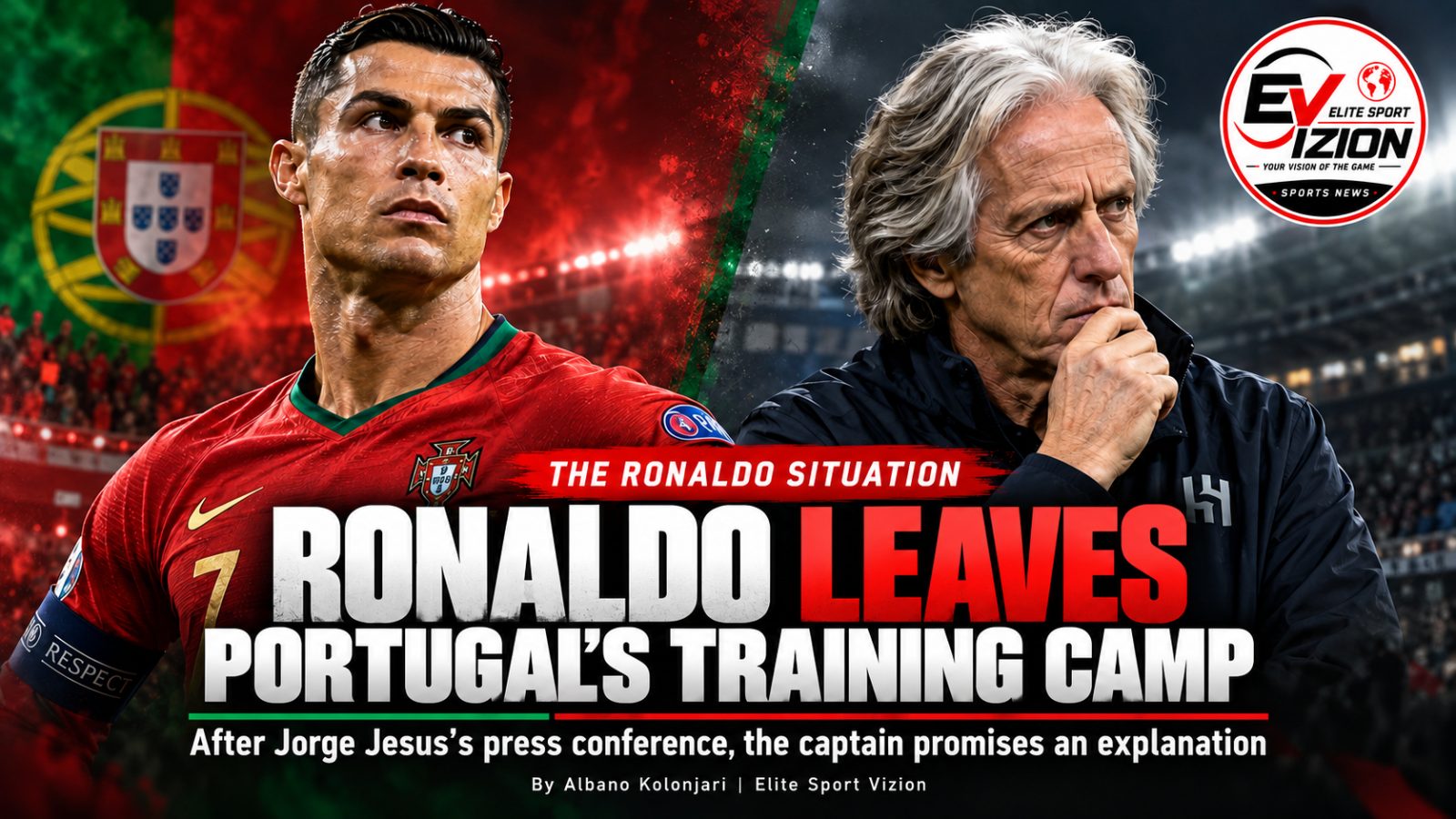
Ronaldo Leaves Portugal’s Training Camp: Jorge Jesus’s Remarks Fuel a Crisis That Remains Unexplained
Three days without training with the squad, a press conference intended to calm the situation, and a departure that raises further questions. Cristiano Ronaldo has decided to leave Portugal’s training camp, while the full reasons behind his decision remain unclear
The Cristiano Ronaldo situation has taken a dramatic turn ahead of Portugal’s meeting with Denmark. What coach Jorge Jesus described as a routine matter of managing a player has developed into a debate about the relationship between the captain, the coach, and the national team’s leadership.
According to the material reported by A Bola and relayed by Calciomercato, Ronaldo missed group training for the third consecutive day. He subsequently left Copenhagen’s Parken Stadium and, later, the national team’s camp.
His departure followed Jorge Jesus’s press conference, during which the coach denied that the forward had refused to train and insisted that he would return to work with the squad.
The discrepancy between what was announced publicly and what happened afterward has placed the issue firmly in the spotlight. However, until those involved provide a full explanation, it remains unclear what ultimately prompted Ronaldo’s decision.
From a Promised Return to a Departure from the Stadium
At the press conference before the Denmark match, Jorge Jesus attempted to ease the tension. He described Ronaldo’s absence from group sessions as part of an individual training program and rejected suggestions that the player had refused to train.
But according to A Bola, the Portuguese captain did not join the squad on the pitch after the press conference.
While the rest of the team, apart from Francisco Conceição, had begun training, Ronaldo left Parken in a national team vehicle, accompanied by staff members. According to the report, Danish media also captured images of his departure.
Those images do not explain the reason for his decision. They do show, however, that his announced return to group training did not take place.
For a team preparing for an important match, this development created another concern: public attention shifted away from the opposition and sporting preparations toward the captain’s immediate future within the squad.
The Explanation for His Individual Work in Malmö
The previous day, in Malmö, Sweden, Ronaldo had appeared on the pitch for a few minutes before training began. He then returned to the hotel in a vehicle provided by the Portuguese Football Federation.
On that occasion, the federation’s explanation concerned the training facilities: the stadium gym lacked the specific equipment required for his individual program.
This clarification matters when examining the sequence of events. An absence from group training does not, by itself, prove that a player has refused to work. A footballer may follow a separate fitness program, perform recovery or strengthening exercises, and miss some or all of a group session.
Jorge Jesus based his explanation on precisely that distinction. The coach insisted that Ronaldo had been working and that interpreting the situation as a refusal to train was incorrect.
But developments in Copenhagen took the story beyond a discussion about an individual program. Ultimately, the issue became the captain’s departure from the camp.
The Federation Confirms His Departure but Does Not Explain Why
The Portuguese Football Federation confirmed that Cristiano Ronaldo had left the national team’s camp.
In the statement reproduced in the supplied material, the federation stressed that preparations for the upcoming matches would continue with the remaining 24 players, maintaining full concentration on results.
The message was brief and focused on the continuation of the team’s work. It confirmed the change in the squad but offered no detailed explanation of what had happened.
It did not clarify whether Ronaldo’s departure resulted from a sporting disagreement, the way the coach and player had communicated, or another circumstance.
That lack of explanation left room for interpretation. For now, the reported facts must be distinguished from speculation: Ronaldo has left the camp, but the full reasons have not been made public.
Ronaldo: “At the Right Time, I Will Explain My Reasons”
Cristiano Ronaldo subsequently responded on social media.
The forward connected his decision to developments following the coach’s press conference and a conversation with Portuguese Football Federation president Pedro Proença.
“After the national team coach’s press conference and after a conversation with the president of the Portuguese Football Federation, I decided to leave the national team’s camp,” he wrote, according to the statement reproduced in the supplied material.
Ronaldo offered no further details about the reason for his departure. Instead, he said he would speak at another time:
“At the right time, I will tell all Portuguese people the reasons that led me to leave the national team, to which I have always been dedicated.”
He concluded by wishing Portugal and all his teammates good luck, without exception.
The message confirms his personal decision to leave, but it does not constitute a clear announcement of permanent retirement from international football. Such a conclusion would go beyond what he has publicly stated.
What remains is a departure accompanied by a promise of further explanation.
What Did Jorge Jesus Say About Ronaldo’s Place on the Bench and His Warm-Up?
Another central issue at the press conference was how the coach had handled the captain’s potential involvement in the match.
Jorge Jesus explained that he had told Ronaldo he would not play in these two fixtures. Nevertheless, during the game, he thought he might need the forward’s contribution and sent him to warm up.
Ultimately, he decided not to bring him on.
The coach acknowledged that such a situation could cause frustration. A footballer who spends a considerable amount of time warming up and then does not enter the match can naturally feel disappointed. According to Jesus, that applies to every player, including the biggest names in football.
But acknowledging that frustration did not mean reversing his sporting decision. The coach insisted that everyone within the squad has equal rights and that decisions about playing time belong to him.
This is where the most sensitive aspect of the story emerges: the possible clash between the expectations of an enormously influential captain and the coach’s authority to determine the lineup, minutes, and individual roles.
“He Did Not Refuse to Train”
Jorge Jesus was categorical when asked about Ronaldo’s absence from group training.
He said the forward had worked in the gym, performed mobility exercises on the pitch, and completed additional muscle-strengthening work at the hotel.
“He did not refuse to train,” the coach repeated.
He also expressed surprise at the suggestion that an international player could simply refuse a training session without making a broader decision to leave.
Jesus assured reporters that Ronaldo would train that day and that they would be able to see him taking part in the session.
According to the subsequent report, that did not happen. However, without knowing what was discussed after the press conference and during the conversation with the federation president, it is impossible to determine whether the coach was describing a plan that later changed or a situation he no longer fully controlled.
That is one of the questions those involved still need to answer.
The Conversation with the Captain and the President’s Involvement
The coach also discussed his conversation with Ronaldo, claiming that he had been forced to address an issue that, in his view, had been exaggerated by public debate.
Jesus said the captain had expressed his willingness to accept the coaching staff’s decisions: if asked to play, he would play; if required to sit in the stands, he would accept that as well.
He also mentioned Pedro Proença’s presence and the president’s interest in understanding what was being discussed in Portugal.
According to the coach’s account, the matter had been resolved after dinner.
Ronaldo’s subsequent departure shows that this assessment was not enough to ensure that the camp continued normally. It does not, by itself, establish what remained unresolved, but it makes a fuller explanation necessary.
The Strongest Statement: No One Changes the Coach’s Decisions
Toward the end of his explanation, Jorge Jesus firmly defended the authority that comes with his position.
He said he could place a player on the bench and use him only if he considered it necessary for the team.
“No player will ever make me change my mind. Neither him nor anyone else in the world of football. Nor any president,” Jesus said, according to the supplied material.
From a sporting perspective, responsibility for selection and playing time rests with the coach. But the way those decisions are communicated is also part of managing a team.
When the player involved is the captain, every public statement carries greater weight. It can be interpreted as a tactical explanation, a defense of the team’s hierarchy, or a message directed at the player himself.
It is not yet known whether Ronaldo perceived the press conference in that way. His statement places it within the sequence of events leading to his departure, but it does not identify which words or circumstances influenced his decision.
Portugal Faces Two Immediate Tasks
For Portugal, the situation creates two immediate priorities.
The first is sporting: the team must continue its preparations and face its upcoming matches with the players available.
The second concerns trust and communication: the federation, the coach, and the captain need to clarify an incident that has left many questions unanswered.
Ronaldo has said he will provide his account at the appropriate time. Until then, any claim of a permanent split, a deliberate refusal to train, or a specific cause of the dispute remains unsupported by a full public explanation.
The statements in this story are forceful, but the answers remain incomplete. Jesus has defended his authority. Ronaldo has decided to leave. The federation has confirmed that work will continue with 24 players.
What is missing is an explanation connecting those three positions.
Until it arrives, Portugal will have to prepare for its opponent while continuing to confront the central question off the pitch: what happened that made the captain decide to leave?
This article is based on the supplied material, which relays reporting from A Bola and Calciomercato.