 Football
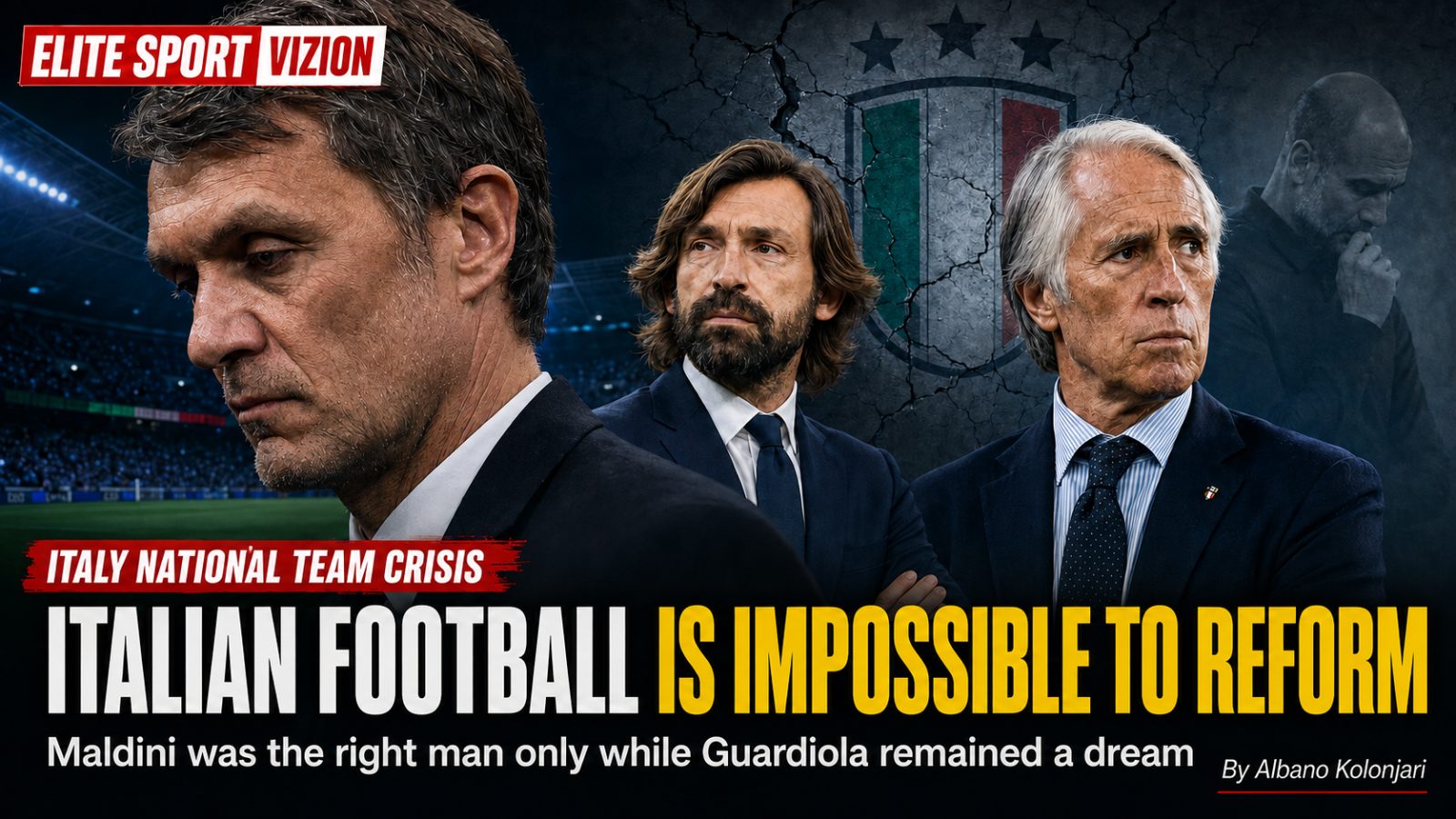
The Andrea Pirlo Affair Reminds Us That Italian Football Is Impossible to Reform: Maldini Was the Right Man Only While Guardiola Remained a Dream
The Russian Connection or Merely a Pretext?
The Italian football system has an innate ability to stop every attempt at change the moment it begins to take shape.
Italian football possesses a “talent” that it has refined into an art over the years: whenever it sees an opportunity for change, it finds a way to prevent it.
It is not bad luck or improvisation. It is almost an instinct for self-preservation. In Italy, revolutions often end before they even begin. The events of the past few days appear to be yet another confirmation.
Chasing a Utopia
Giovanni Malagò worked hard to convince Paolo Maldini. He approached him, persuaded him and eventually entrusted him with the Italian national team’s technical project.
After considerable hesitation, Maldini accepted the position and brought Leonardo with him. The idea was not simply to appoint a new head coach but to build a structure capable of restoring the national team’s football identity and reforming the entire system.
At the heart of that project was an enormous ambition: Pep Guardiola.
A utopian dream? Probably. But sometimes utopias help reveal who has the stature and authority to try to turn them into reality. Maldini possessed that stature. If there was one person in Italy who could make a phone call to Guardiola seem credible, it was Maldini.
Then reality intervened. Guardiola remained Guardiola, while the plan shifted toward Andrea Pirlo.
Pirlo Failed to Convince
This is where an important distinction must be made, because Pirlo was far from an unquestionable choice.
His coaching career does not yet provide sufficient guarantees. His development remains incomplete, and those who questioned his candidacy had entirely legitimate arguments.
Reality should not be rewritten: Pirlo failed to convince a large section of public opinion. The writer of these lines was among the first to express doubts.
However, debating a technical decision is one thing; searching for a reason to block it is another. That was precisely when the Fonbet controversy resurfaced.
Malagò to Maldini: “Now I Decide”
Frankly, the situation raises a bitter smile—not because of the controversy itself, but because of how it was used.
Italian football has an extraordinarily selective memory. Principles become absolute when they are useful and surprisingly flexible when they become inconvenient.
In recent days, memories of the famous “code of ethics” have resurfaced. Do you remember Cesare Prandelli’s ethical code?
That supposed “moral revolution” produced only one concrete consequence: the sacrifice of Mimmo Criscito, who was excluded from the national team before the case against him was eventually dismissed entirely.
The moral lesson remained. So did the scapegoat.
Italian-Style Hypocrisy
According to La Repubblica, the final confrontation between Malagò and Maldini followed the decision to block Pirlo’s appointment.
The FIGC president reportedly called Maldini on Sunday evening and made it clear that Pirlo’s contract with the Russian betting company Fonbet represented an “insurmountable and unsustainable” obstacle.
The following morning, Malagò called Maldini again and confirmed that there was no possibility of reconsidering the decision.
Malagò reportedly told Maldini:
“Choosing Pirlo was a mistake. But I am the president. At this point, I will take responsibility and make the decision.”
At that moment, Maldini understood that the autonomy he had been promised—and had demanded as a condition for accepting the role—was limited in practice.
He also realized that Malagò was unwilling to confront Serie A clubs, political pressure and public controversy to protect his project.
The Russian Connection or Merely a Pretext?
The two executives did not directly address the Russian aspect of the controversy. Maldini suspected that Malagò had made no real attempt to contain it.
Pirlo’s collaboration with Fonbet did not create any legal obstacles, although the contract would have needed to be terminated immediately for institutional and reputational reasons.
For Maldini, the Fonbet affair was merely a pretext. The real issue was Pirlo’s résumé, his limited coaching experience and the opposition to his candidacy—not simply his inappropriate role as an ambassador for a Moscow-based company.
Maldini eventually called Malagò to announce his departure:
“Leonardo and I are ending our collaboration with the national team. We accept responsibility for an inappropriate choice.”
Mancini Returns as the Leading Candidate
Following the sudden departure of Maldini and Leonardo, Roberto Mancini has returned as the leading candidate to become Italy’s new head coach.
Maldini felt restricted and deprived of the autonomy he had been promised. Malagò, meanwhile, reportedly concluded that someone who publicly declared Guardiola to be his target and then proposed Pirlo was not truly suited to lead a federation’s technical project.
But that is precisely the heart of the problem: Maldini was considered the right man as long as the project was built around the dream of Guardiola. The moment he made a concrete decision and accepted responsibility for it, his autonomy ended.
That is the story of Italian football: change is welcomed only while it remains an idea. The moment it threatens to become reality, the system intervenes to stop it.